Indian art forms represent a vast, diverse heritage spanning thousands of years, encompassing painting, sculpture, architecture, textiles, and tribal crafts. Key traditional painting styles include Madhubani, Warli, Pattachitra, Kalamkari, and Tanjore. These art forms often reflect cultural, spiritual, and regional stories using natural dyes, intricate patterns, and, in cases like Miniature Paintings, precious stone colors.
The Indian styles of paintings have unique origins and history behind them which make them even more interesting. This exhaustive list of different types of Indian paintings shows how every part of India added to its rich cultural heritage.
- West Bengal –
A. Kalighat Painting
Originated in the 19th century Bengal, from Kalighat. It was the time when upheaval against the British was a possible, exciting idea. These paintings, on cloth and pattas, at first depicted Gods and Goddesses, but then took a turn towards social reform. With cheap paper and paint colours, squirrel hair brushes and colour pigments, the art was characterised by flawless strokes, brushwork, and simple but bold drawings. It sought to raise awareness about social conditions in its viewers – rich zamindars were depicted drinking wine with women, while priests were shown with ‘unchaste’ women and police babus being sloppy.
B. Dhokra Art
Dhokra art is a 4,000-year-old traditional Indian tribal metal craft, utilizing the lost-wax casting technique to create unique brass, nickel, and zinc alloy figurines. Primarily practiced in West Bengal, Odisha, Chhattisgarh, and Jharkhand, this rustic, eco-friendly art form features intricate, handcrafted patterns often depicting deities, tribal legends, animals, and daily life.
Key Aspects of Dhokra Art:
- Technique: The “lost-wax” method (cire perdue) involves creating a clay core, covering it with beeswax threads, applying an outer clay layer, and melting the wax out to fill it with molten metal.
- Themes & Motifs: Common subjects include elephants (strength), owls (prosperity), horses, musicians, tribal deities (Ganesh, Durga), and daily activities.
- Characteristics: These items have a distinctive antique, raw, and brownish-gold look, often featuring wire-work finishes.
B. Terracotta Art
The state of West Bengal has a tradition of terracotta art that goes back thousands of years. From the terracotta temples and the iconic Bankura horse of the Rarh region, to the idols and sculptures made in the bylanes of Kolkata, this art form is an integral part of Bengali culture.
Terracotta is an Italian term that roughly means ‘baked earth’, and refers to clay items that have been hardened by heating them to around 1,000°C. The earliest terracotta artifacts discovered are close to 5,000 years old, and many cultures around the world have a rich terracotta tradition.
Terracotta became widespread in India around 3,500 years ago, with Bihar, Jharkhand, Rajasthan, Tamil Nadu and West Bengal all developing their own styles. West Bengal in particular, with its rivers and fine clay, was the perfect place for it to take root and evolve into an art. Since then, Bengalis have used terracotta not just for everyday utensils, but for sculptures, tiles and even murals.
- Odisha – Pattachitra
Pattachitra folk painting hails from the state of Orissa. They originated during the 8th century and is suppose to be one of the earliest forms of indigenous art. ‘Patta’ means ‘clothing’ and ‘chitra’ stands for paintings, so pictures in this art form are painted on a cloth base. Pattachitra art is inspired by the Jagannath and Vaishnava culture. Depictions of Pattachitra art can be seen in the famous Konark Temple in Orissa.
3. Rajasthan
A. Phad Painting

Phad is the narrative scroll painting tradition from Rajasthan, dating back to a thousand years. Stories of local deities and heroes are painted on horizontal cloth scrolls in hues of red, yellow and orange The Phad scrolls show depictions of battlefields, adventure stories, legendary romances and the richness of the Indian princely states. The Phad painting style leaves one spellbound at how the folk artists accommodate multiple stories in a single composition, yet maintain the aesthetics of artistic expression.
B. Miniature Painting
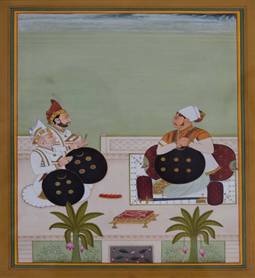
The Miniature painting style came to India with the Mughals in the 16th century and is identified as an important milestone in the history of Indian art. It developed into a distinct style with a combination of Islamic, Persian and Indian elements. The painting is done using natural stone colors on a paper-based “wasli”. Mineral colors, precious stones, conch shells, gold and silver are used in the miniatures. Fine brushwork, intricacy, detailing and stylization are the unique attributes of miniature painting. Across India, the miniature painting style has developed into distinct schools of miniature paintings like Kangra, Rajasthan, Malwa, Pahadi, Mughal, Deccan etc. to name a few.
C. Pichhwai

Pichwai Painting
The Indian art of Pichwai originated as wall hangings behind the main deity in Krishna temples in Nathdwara. They narrate stories related to Lord Krishna. Gradually with commercialisation secular themes are also incorporated in the Picchwai style of painting. Picchwais are colourful and intricate works of art with concealed symbolism in the artistic motifs. This distinct devotional art practice has passed from one generation to another and a fine example of spirituality in art.
C. Blue Pottery
Pottery in Rajasthan is a vibrant art form, most famously highlighted by Jaipur’s 400-year-old Blue Pottery, which uses quartz stone powder instead of clay, along with distinctive terracotta from Molela. These glazed, low-fired blue items often feature floral and animal motifs, while rural areas also produce traditional pottery.
Key Aspects of Rajasthan Pottery
- Jaipur Blue Pottery: Originating from Turko-Persian influences and brought to Jaipur by Maharaja Sawai Ram Singh II, this technique is unique because it uses no clay, relying instead on quartz powder, powdered glass, Multani Mitti (Fuller’s earth), and gum. The signature colors are blue, green, and white, with yellow and brown often added.
- Molela Terracotta: Known for its rustic, artistic, and ceremonial items, Molela village specializes in creating idols and murals, often depicting local deities.
- Sawai Madhopur Black Pottery: Another prominent type of pottery, this style uses clay to produce a unique, rustic look and is considered a distinctive craft from the region.
- Common Products: Products include vases, coasters, glazed tiles, surahis (pitchers), tea sets, soap dishes, and decorative door knobs.
D. embroidered Patch work
Embroidery has given a new meaning to the word art. It is a time-consuming work of stitching various designs onto the cloth by hand. From being an emblem of royalty, it’s now worn all over the world as an intricate piece of clothing and for its beautiful designs.
Whether you are looking for an item that’s worth gifting or something that could inspire the interior of your home, an embroidered or hand made gift will make you stand apart from the crowd. One such art form is Heer Bharat and Appliqué Embroidery from Rajasthan.

- Bihar – Madhubani Painting
One of the most celebrated styles of Indian art is, Madhubani which originated in the Mithila region of Bihar as a form of wall art.This spectacular folk art style was unknown to the outside world until discovered by the British colonial William G. Archer in 1934 while inspecting the damage after the massive Bihar earthquake. Archer was amazed by the beautiful illustrations on the exposed interior walls of the houses…The beauty of Madhubani lies in its simple and evocative portrayal of culture and traditions.
The designs are characterised by eye-catching geometrical patterns, symbolic images, and scenes from mythology. The balance between the vibrancy of colors and simplicity in its patterns make Madhubani different from other painting styles. Bharni, Katchni, Tantrik, Godna, and Kohbar are the five distinct styles of Madhubani painting.


Madhubani Tanjore
5. Tamil Nadu – Tanjore
Tanjore style of paintings were first painted during the 16th century and under the Chola regime, this art form found its calling. Known for its use of vibrant colours, rich surfaces, and embellishments, Tanjore paintings originated from the Thanjavur district in Tamil Nadu. The themes of Tanjore paintings are mostly Hindu Gods and Goddesses. Interestingly, the main subject is always painted in
the center of the frame. Tanjore Paintings are painted on wooden planks which are colloquially known as ‘Palagai Padam‘.
6. Warli Paintings

This ancient Indian art is 2500-year-old tradition. Warli paintings of the Thane and Nasik areas of Maharashtra are closely linked with nature and social rituals of the tribe. Warli paintings showcase daily activities of the local people of that community like farming, dancing, hunting, praying etc. Traditionally, women used twigs to draw lively designs with rice paste on mud walls of tribal houses to mark celebrations of harvests or weddings. Simple geometrical patterns in white against a red or yellow surface are used to depict everyday life scenes. Warli art with its linear and monochromatic hues resembles the execution of pre-historic cave paintings.
7. Kalamkari
This 3000-year-old organic art of hand and block printing was traditionally used for making narrative scrolls and panels. This exquisite folk art has a strong connect with Persian motifs. Kalamkari derives its name from kalam or pen and is a legacy that has been handed down from generation to generation in Andhra Pradesh. The stylised animal forms, floral motifs and mehrab designs predominant in Kalamkari paintings have also found a place in Kalamkari textiles. Kalamkari art primarily involves earthy colours like indigo, green, rust, black and mustard.
- Tripura – Bamboo Work
Cane & Bamboo Handicrafts of Tripura – among the best in the country. 60% of the requirement of the entire country for bamboo sticks for Agarbatti-making is met from the State. Tripura Bamboo Mission (TBM) has been launched in 2007, under PPP framework, for integrated development of Bamboo Sector.
- Uttar Pradesh – Sanjhi
Sanjhi Painting is a tradition of art that originated out of the cult of Krishna and flourished in the north Indian state of Uttar Pradesh. It is in Vraja, or Vrindavan, the homeland of Lord Sri Krishna, that this art of Sanjhi painting reached its pinnacle. This art painting is rooted in the folk culture of the region. It was taken to its glory by the Vaishnava temples in the 15 th and 16 th century. Sanjhi came to be regarded as a highly refined art form practiced by the Brahmin priests.
- Gujrat
A.Rogan Art
Rogan art is a 400-year-old, intricate textile art from Nirona, Gujarat, where artisans create freehand paintings using thick, castor oil-based paints. Using a metal rod to trail paint, artists produce detailed, mirrored designs like the “Tree of Life” by folding the fabric. This rare, labor-intensive craft is primarily practiced by the Khatri community, with renowned artists like Padma Shri Abdulgafur Khatri preserving the tradition.
Key Aspects of Rogan Art Painting
- Technique: Castor oil is boiled for over eight hours to create a viscous paste, which is mixed with natural pigments. The artisan paints by trailing the thread-like paint with a metal stylus (tulika) and guiding it with their hand underneath the fabric.
- Process: The design is painted on one half of the fabric, which is then folded to create a perfectly symmetrical mirror image.
- Motifs: Common designs include intricate floral patterns, peacocks, geometric forms, and the famous “Tree of Life”.
- Origin: The art originated in Persia but has been practiced in the Kutch region of Gujarat for over 400 years.
- Authenticity: Rogan art has received the Geographical Indication (GI) Tag of India, ensuring the protection of its traditional methods.
B.Lippan Art
Lippan art, or mud and mirror work, is a traditional mural craft from Kutch, Gujarat, featuring intricate, textured mud designs adorned with small mirrors. Historically used to decorate bhungas (mud huts), this eco-friendly art form is now popular for modern home decor, often created using white clay/putty and mirrors on MDF boards.
Key Aspects of Lippan Art
- Origin: It hails from the Kutch region of Gujarat, traditionally done on walls by local communities to brighten their homes.
- Materials: Traditionally, it uses a mixture of clay and camel dung, while modern, durable versions use white clay, moulding clay (like Fevicryl Shilpkar), PVA glue, and acrylic colors.
- Key Components: The artwork is characterized by high-contrast designs, often using geometric shapes and small, shaped mirrors called Abhla.
- Common Motifs: Designs often feature scenes from daily life, nature, such as peacocks, camels, trees of life, or geometric, religious patterns like Mandalas and Ganesha.
Except this you can also buy Original Drawings and pause to witness the mastery of strokes in drawing form. Discover the most unique and creative outcomes from brilliant, eminent artists from our store. You can also meet them. Explore the vast collection of sketches and drawings , where each original piece is available at affordable price, inviting you to own a unique story. Our curated collection showcases the most powerful and experienced strokes, capturing the essence of pure creativity. Aikyam is your ultimate art platform, featuring a diverse range of sketches and drawings, providing a space for artists and art enthusiasts alike. Enjoy an impeccable shopping experience for home decor, hotels, corporate purposes, or art investment, and consider gifting art as a token of love to your dear ones, allowing them to experience the delicacy of owning a drawing. Elevate your space with the authenticity and depth of the original art drawings and sketches available at Aikyam store.